Height Calculator
This height calculator predicts your child's adult height from their age, height, weight and parents' heights, usually within about 2 inches.
Height Predictor (Based on Parents' Heights)
This height predictor estimates a child's adult height from the mother's and father's heights alone, at any age.
Height Converter
This height converter turns feet and inches into cm, or cm into feet and inches, instantly.
How to convert height by hand:
- 1 inch = 2.54 cm, and 1 foot = 30.48 cm.
- Feet to cm: (feet × 12 + inches) × 2.54. Example: 5'7" = 67 × 2.54 = 170 cm.
- cm to feet: cm ÷ 2.54 = inches, then divide by 12 for feet. Example: 160 cm = 63 inches = 5'3".
How to Use This Height Calculator
It takes less than a minute.
- Pick your units: US (feet, inches, pounds) or Metric (cm, kg).
- Choose Boy or Girl, then enter your child's age, height and weight. Measure without shoes if you can.
- Add the real heights of both biological parents.
- Click Calculate. You'll see the predicted adult height in feet and cm, with a range.
Say your son is 10, his mom is 5'5" and his dad is 5'11". The parents-only calculator puts him at about 5'10½". Add his current height and weight to the first calculator and it will fine-tune that number.
How Tall Will I Be?
How tall you will be depends mostly on your parents' heights and how far you are through puberty. Enter your age, height, weight and both parents' heights in the height calculator above to see your predicted adult height.
Asking "how tall am I going to be?" A real prediction from your own numbers beats a guess every time.
What decides how tall you'll be:
- Genes: about 60 to 80% of your height comes from your parents.
- Food, sleep and health make up the rest.
- Tall parents usually have tall kids, but kids of very tall or very short parents tend to land a little closer to average.
- Timing: most girls stop growing at 14 or 15, most boys at about 16, and some boys grow a little until 18.
- Growth spurt: two friends who are both 5'4" at 13 can end up very different, because one may have had their spurt already.
"If I'm 5'4" at 12, how tall will I be?"
People search their own numbers all the time:
- "If I'm 5'6" at 13, how tall will I be?"
- "How tall will I be when I grow up?"
The answer depends on your sex, weight and parents' heights. Put your numbers into the how tall will I be calculator above and you'll have it in seconds.
Just remember that your result is an estimate, not a promise. Think of it as your likely future height, give or take a couple of inches.
Expected Adult Height: What Your Height Calculator Result Means
The number you get is the child's predicted height as an adult, sometimes called their estimated height. You'll also see it called expected adult height or projected height. Under it is a range, and most kids end up somewhere inside it.
Whether you call it a height predictor, height estimator, child height calculator or adult height calculator, every tool answers one question: how tall will my child be? Only the math behind them changes, which is why two websites can give two different numbers.
How our child height predictor works:
- Height and weight entered: it uses the Khamis-Roche method.
- Only parents' heights entered: it uses the mid-parental method.
- Your result shows height potential, not a fixed maximum height, and every height estimate comes with a range.
- Good food, enough sleep and good health help a child reach it. Long illness or poor nutrition can hold growth back.
How to Predict Height: 5 Height Prediction Methods
The most accurate way to predict height at home is the Khamis-Roche method, which uses the child's age, height, weight and parents' heights. The simplest is the mid-parental formula: average the parents' heights, then add 2.5 inches (6.5 cm) for a boy or subtract the same for a girl.
If you've wondered how to tell how tall your child will be, or how to calculate height by hand, here's how to predict child height with each of the 5 methods.
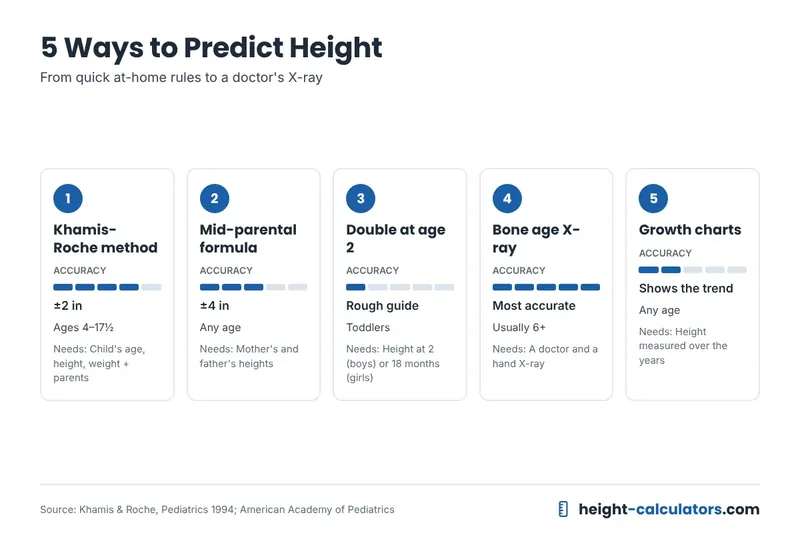
1. Khamis-Roche Method (Most Accurate Height Predictor)
Our first calculator uses this method. It looks at four things:
- your child's age
- current height
- current weight
- the average of the parents' heights
Good to know:
- There's a separate equation for each age, and for boys and girls.
- It works for kids aged 4 to 17½.
- For most children it lands within about 2 inches of their real adult height.
- It was built from data on American children, so it may be a little less exact for other ethnic groups.
2. Mid-Parental Height Formula
The mid-parental height is the simplest formula for height, and the one doctors use most. It's what the second calculator uses, so you could call it a genetic height calculator. You only need the mother's and father's heights. Here's the height equation:
- Formula for a boy: (father's height + mother's height + 5 inches) ÷ 2
- Formula for a girl: (father's height + mother's height − 5 inches) ÷ 2
Working in cm? Use 13 cm instead of 5 inches. The extra 5 inches is there because men are about 5 inches taller than women on average.
Example: "If my mom is 5 ft and my dad is 6 ft, how tall will I be?" Mom is 60 inches, dad is 72 inches.
- Boy: (72 + 60 + 5) ÷ 2 = 68.5 inches, about 5'8½"
- Girl: (72 + 60 − 5) ÷ 2 = 63.5 inches, about 5'3½"
Same example in cm: mom 160 cm, dad 175 cm.
- Boy: (175 + 160 + 13) ÷ 2 = 174 cm
- Girl: (175 + 160 − 13) ÷ 2 = 161 cm
Most kids end up within 4 inches of this number, taller or shorter. It's a good starting point, but if your child is 4 or older, the first calculator will get you closer.
3. 2 Year Old Height Predictor: Double the Height at Age 2
This is the old rule your grandparents might know. Take a boy's height at age 2, or a girl's height at 18 months, and double it. It's a quick check, and it's often closer than you'd expect.
4. Bone Age Height Prediction (X-ray)
- The most accurate method of all, but not something you can do at home.
- A doctor X-rays the hand and wrist to see how mature the growth plates are.
- This shows how much growing time is left.
- Doctors usually order it only when they're worried about a child's growth.
5. Height Growth Charts
At every checkup, your pediatrician marks your child's height on a growth chart. Most kids stay close to the same curve as they grow, so following that curve forward gives a rough idea of their adult height.
How Tall Will My Son or Daughter Be?
Most boys reach their adult height around 16, and most girls around 14 or 15. Choose Boy or Girl in the height calculator above, because the height calculator for boys and the height calculator for girls use different equations.
How tall will my son be?
- Growth spurt: usually between 12 and 15, later than girls.
- When he stops: most boys stop growing around 16; some grow a little until 18.
- Shorter than his friends at 12 or 13? Don't panic. He may not have hit his growth spurt yet.
- Why our tool helps: the height predictor for boys uses his current height and weight, so it can tell the difference far better than a guess.
How tall will my daughter be?
- Growth spurt: usually between 10 and 14.
- After her first period: most girls grow only 1 to 2 more inches.
- When she stops: most girls reach adult height by 14 or 15.
- Tall at 11? She may already have done most of her growing. The height predictor for girls takes this into account.
Tips for an Accurate Kid Height Prediction
- Measure your child in the morning, without shoes.
- Use the real heights of both biological parents, not a guess. A 1-inch mistake changes the answer.
- Check again once a year. Every new measurement makes the prediction more accurate.
Baby Height Predictor
Want to know how tall your baby will be? Use the second calculator above, the one based on parents' heights. This baby height calculator works for newborns, toddlers and even babies who aren't born yet.
Why the first calculator is only for age 4 and up:
- Before 4, kids grow in quick bursts, so their current height says little about adult height.
- A baby's length at birth depends more on the pregnancy than on genes.
The age-2 rule for toddlers:
- Boys: double his height at age 2.
- Girls: double her height at 18 months.
- Example: a 2-year-old boy who is 34½ inches tall comes out at about 69 inches, or 5'9".
- Treat it as a fun 2 year old height predictor. Once your child turns 4, use the full height predictor for a better answer.
Average Height by Age for Boys and Girls
The average 12-year-old is about 4'11" (boys) or 4'11½" (girls), and the average 15-year-old is about 5'7" (boys) or 5'3½" (girls). The table below shows average heights for ages 8 to 17 from the CDC growth charts.
Use it to answer questions like "how tall are you supposed to be at 12?" or "how tall should a 15 year old girl be?" "Average" here means the middle: half of kids that age are taller, half are shorter.
| Age | Boys (ft/in) | Boys (cm) | Girls (ft/in) | Girls (cm) |
|---|---|---|---|---|
| 8 | 4'2½" | 128.0 | 4'2½" | 127.8 |
| 9 | 4'4½" | 133.9 | 4'4½" | 133.1 |
| 10 | 4'6½" | 138.9 | 4'6½" | 138.2 |
| 11 | 4'8½" | 143.8 | 4'9" | 144.3 |
| 12 | 4'11" | 149.4 | 4'11½" | 151.4 |
| 13 | 5'1½" | 156.5 | 5'2" | 157.2 |
| 14 | 5'4½" | 164.1 | 5'3" | 160.5 |
| 15 | 5'7" | 170.2 | 5'3½" | 161.8 |
| 16 | 5'8½" | 173.7 | 5'4" | 162.6 |
| 17 | 5'9" | 175.3 | 5'4" | 162.8 |
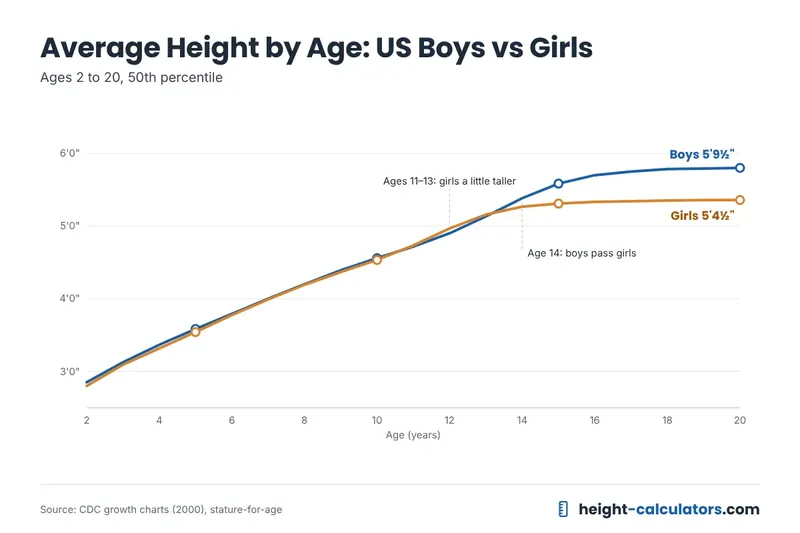
Source: CDC growth charts (2000), 50th percentile, rounded to the nearest half inch.
How tall should I be at 12, 13, 14 or 15?
- There's no exact height you should be. Healthy kids come in a wide range of heights.
- A 15-year-old girl at 5'3½" is average, but 4'11" or 5'7" can be just as healthy.
- Girls are a little taller than boys at 12 and 13. Boys pass them at 14, because girls have their growth spurt earlier.
- Steady growth matters more than any single number. To see exactly where your child stands, use our height percentile calculator.
Average Height in the United States
The average American man is about 5'9" (68.9 inches) and the average American woman is about 5'3½" (63.5 inches). These are measured heights of US adults aged 20 and over, from CDC surveys taken in 2021–2023.
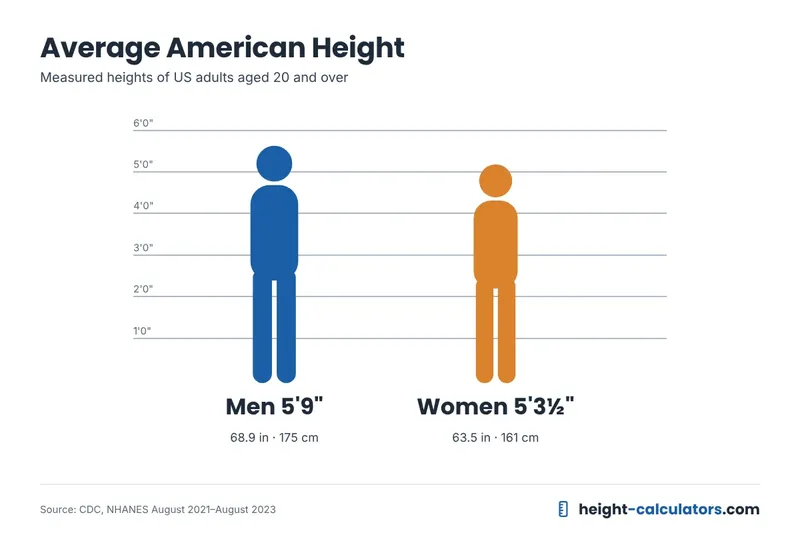
- Men: 68.9 inches, about 175 cm.
- Women: 63.5 inches, about 161 cm.
- Barely changed in 20 years: the average US man was 69.2 inches in 1999–2000 and 69.1 inches in 2015–2016.
- Taller than 60 years ago: in the early 1960s, the average American man was a little over 5'8".
- Kids are tracked the same way: US pediatricians plot children on CDC growth charts from age 2, and WHO charts before that. Our height calculator uses the same data and shows US units first.
How Tall Am I? How to Measure Your Height at Home
To measure your height at home, stand barefoot against a wall, rest a flat book on your head, mark the wall under it and measure from the floor to the mark. For an accurate height measurement, all you need is a wall, a hardback book and a tape measure.
- Take off your shoes and stand on a hard floor, not carpet.
- Stand with your back flat against a wall. Your heels, bottom, shoulders and head should touch it.
- Keep your feet together and look straight ahead.
- Ask someone to lay the book flat on top of your head, pressed against the wall.
- Mark the wall just under the book with a pencil.
- Measure from the floor to the mark. That's your height.
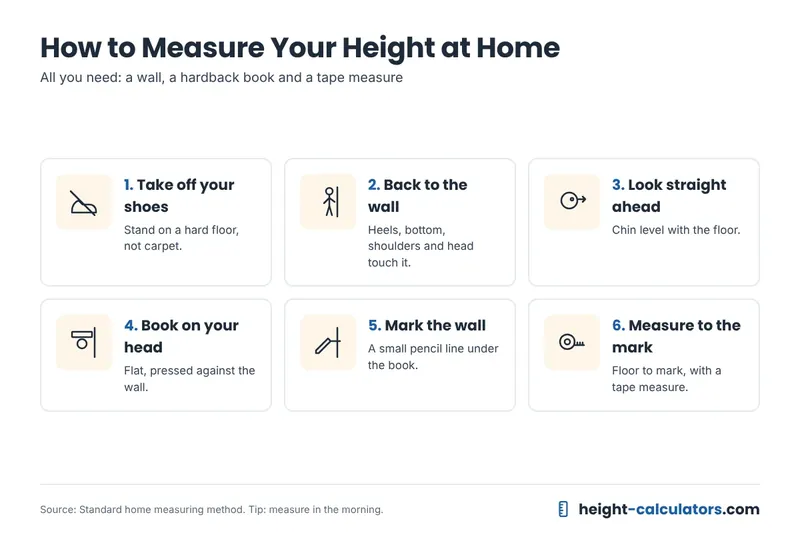
No one around to help? Hold a cereal box flat on your head against the wall, keep it still, step out, and mark under it.
Tips for measuring height:
- Measure in the morning. You're a little taller when you wake up than at night.
- Measure twice and use the average.
- Need your height in cm instead of feet, or the other way round? Use the height converter above.
- No height checker app, online height test or "guess my height" tool beats a tape measure and a wall.
Once you know your height, check it against the average height table above, or put it into the height predictor to see how tall you'll be as an adult.
Is Height Genetic? Factors That Affect Your Height
Yes, height is mostly genetic. About 60 to 80% of the difference in height between people comes from genes, and you get them from both your mom and your dad. That's why every height calculator asks for both parents' heights.
Factors that affect height:
- Genes set the limit.
- Nutrition, sleep and health decide how close you get to it.
- Illness and hormones: long-term poor nutrition, some illnesses, growth hormone or thyroid problems, and some medicines (like long-term steroids) can slow growth.
- Sex: men are about 5 inches taller than women on average, and boys grow for about two years longer.
- Puberty timing: early bloomers shoot up first but often stop sooner. Late bloomers can catch up and pass them.
A height calculator only sees age, height, weight and parents' heights, not food or sleep. That's why every prediction comes with a range.
When Do Boys and Girls Stop Growing?
Most girls stop growing at 14 or 15. Most boys stop at about 16, and some keep adding a little until 18. Growth stops when the growth plates at the ends of your bones close, which happens a few years after puberty starts.
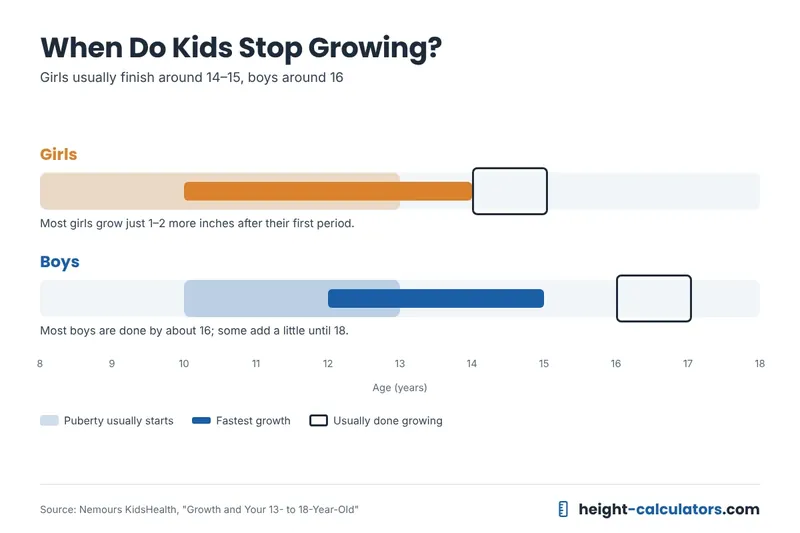
When do girls stop growing?
- Puberty usually starts between 8 and 13.
- Fastest growth is between 10 and 14.
- After the first period, most girls grow only 1 to 2 more inches.
When do boys stop growing?
- Puberty usually starts between 10 and 13, about two years after girls.
- Fastest growth is between 12 and 15.
- By 16 most boys are at or close to their adult height. Muscles keep developing into their 20s.
If you've barely grown in the past year, you're probably at or near your adult height. Only a bone age X-ray can tell for sure whether your growth plates have closed.
How to Become Taller: Can You Really Grow Taller?
You can't grow taller than your genes allow, and once your growth plates close, your height is set. But while you're still growing, healthy habits help you reach your full height. These are the same things doctors recommend for good health anyway:
- Eat real, balanced meals with protein, dairy (or other calcium), fruit and vegetables.
- Sleep 8 to 10 hours a night. Your body releases a lot of its growth hormone while you sleep.
- Stay active every day with sports, walking or play.
- Skip smoking, vaping and alcohol.
Will I grow taller after 18?
- Most people won't grow taller after 18.
- Stretching, hanging from bars and "grow taller" pills can't make bones longer once growth plates close.
- Be careful with anything that promises extra inches.
- Standing up straight helps. Slouching can hide an inch or more.
- If a child is growing much slower than friends, see a doctor. Growth hormone treatment exists, but only for kids with a medical reason.
How Accurate Is a Height Calculator?
A good height calculator is accurate to within about 2 to 4 inches for most kids. Our first calculator (Khamis-Roche) usually lands within about 2 inches for children aged 4 to 17. The parents-only calculator is usually within 4 inches. No height calculator can promise an exact number.
Why do height calculators give different results?
Getting different answers on different websites is normal. Here's why:
- Some calculators use only the parents' heights; others add the child's height and weight.
- Some are built on different data.
- A guessed parent height, or measuring a child in shoes, can move the answer by an inch or more.
- Predictions are less accurate when a parent is very tall or very short, or when a child is much shorter than other kids their age.
What a height calculator can't do
A height calculator gives a good estimate of height potential. It can't:
- diagnose a growth problem
- replace a doctor's check
- tell you your child's final height for certain
When to See a Doctor About Your Child's Height
Talk to your pediatrician if your child:
- is much shorter or taller than almost all kids their age (below the 3rd or above the 97th percentile)
- moves down or up across two or more lines on their growth chart
- grows less than about 2 inches a year between age 4 and puberty
- starts puberty very early, or shows no signs of it by the early teens
- is far outside the range predicted from the parents' heights
Height Calculator FAQ
What is the most accurate height calculator?
The most accurate height calculator you can use at home is one based on the Khamis-Roche method, like the first calculator on this page. It uses the child's own height and weight as well as the parents' heights. Only a bone age X-ray at a doctor's office is more accurate.
Are height calculators accurate?
Mostly, yes, within a range. Expect the real adult height to land within about 2 inches of a Khamis-Roche result, or about 4 inches of a parents-only result. They're less accurate for kids under 4.
How tall should a 12-year-old be?
The average 12-year-old boy is about 4'11" and the average 12-year-old girl is about 4'11½". But a healthy 12-year-old can easily be several inches taller or shorter than that. See the average height by age table above.
Do You Get Height Genetics From Your Mother or Father?
From both. Height comes from many genes, and you inherit them from both parents. That's why a height calculator based on parents always asks for both heights.
Can I use a height calculator with grandparents' heights?
Grandparents can play a small part, since their genes passed through your parents. But your parents' heights already capture most of that, so height calculators don't ask for them.
Is there a height calculator without parents' heights?
Yes, but it's less accurate. You can double a child's height at age 2 (or 18 months for girls), or follow their curve on a growth chart. Growth multiplier methods also predict height from just the child's age and current height.
How tall will I be if I'm 5'6" at 13?
It depends on whether you're a boy or a girl and how tall your parents are. A boy who is 5'6" at 13 is tall for his age and may still grow several more inches. A girl at 13 has usually done most of her growing. Use the how tall will I be calculator above for your own answer.
Will I grow taller?
If you're still going through puberty, almost certainly. If you haven't grown in a year and you're past 15 (girls) or 17 (boys), you're probably at or close to your adult height.
Height Calculator References
- Khamis HJ, Roche AF. Predicting adult stature without using skeletal age: the Khamis-Roche method. Pediatrics. 1994;94(4):504–507.
- Tanner JM, Goldstein H, Whitehouse RH. Standards for children's height at ages 2–9 years allowing for heights of parents. Arch Dis Child. 1970;45(244):755–762.
- Paley J, et al. The multiplier method for prediction of adult height. J Pediatr Orthop. 2004.
- Centers for Disease Control and Prevention. CDC Growth Charts: United States, 2000.
- American Academy of Pediatrics. Mid-parental height calculations.
- Nemours KidsHealth. Growth and your 13- to 18-year-old.
Medical disclaimer: This height calculator gives an estimate for educational purposes only. It does not diagnose or treat any medical condition and is not a substitute for advice from a doctor. If you're worried about your child's growth, talk to your pediatrician.