Waist-to-Height Ratio Calculator
This waist-to-height ratio calculator divides your waist by your height to show your health risk. A ratio under 0.5, meaning a waist less than half your height, is the healthy target for adults and children.
How to Use the Waist-to-Height Calculator
- Measure your height without shoes.
- Measure your waist (see the steps below).
- Enter both in the same unit, inches or cm.
- Click Calculate to see your ratio and what it means.
Waist-to-Height Ratio Chart: What Your Result Means
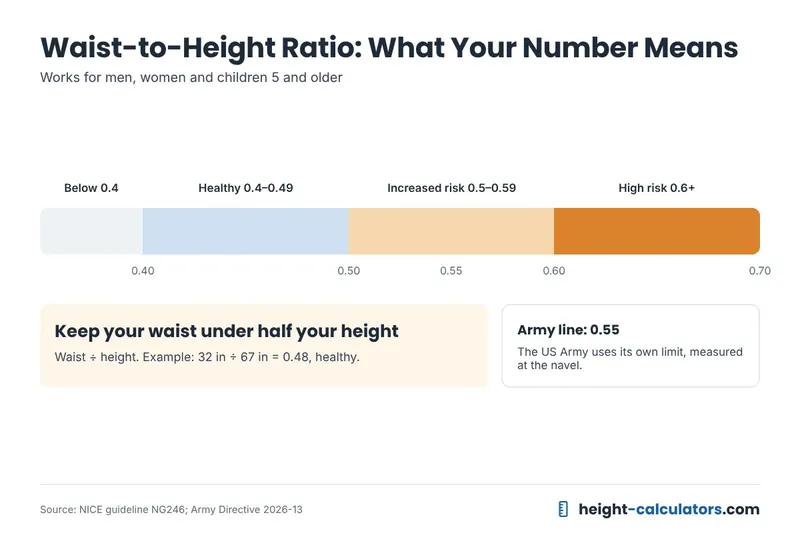
The UK's health guidance body, NICE, uses three simple bands. They work for men and women, all ethnic backgrounds and children aged 5 and up.
| Waist-to-height ratio | What it means |
|---|---|
| 0.4 to 0.49 | Healthy. No increased health risk. |
| 0.5 to 0.59 | Increased health risk. |
| 0.6 or more | High health risk. |
Extra fat around the middle is linked to type 2 diabetes, high blood pressure and heart disease. That's why this ratio is a useful quick check.
How to Calculate Waist-to-Height Ratio
Divide your waist by your height, both in the same unit. That's the whole waist-to-height ratio formula.
- Example in inches: 38 in waist ÷ 67 in height = 0.57 (increased risk)
- Example in cm: 80 cm waist ÷ 170 cm height = 0.47 (healthy)
- Tip: if you know your height in feet, convert it to inches first. 5'7" = 67 inches.
How to Measure Your Waist Correctly
Measure halfway between the bottom of your ribs and the top of your hip bones. This is often a little above the belly button.
- Stand straight and breathe out normally.
- Find the bottom of your ribs and the top of your hips.
- Wrap the tape around the point halfway between them.
- Keep the tape snug but not tight. Don't suck in.
- Read the number and write it down.
Healthy Waist Size by Height
For a healthy ratio, keep your waist under half your height. Here are the limits for common heights.
| Height | Keep waist under |
|---|---|
| 5'0" (152 cm) | 30 in (76 cm) |
| 5'4" (163 cm) | 32 in (81 cm) |
| 5'8" (173 cm) | 34 in (86 cm) |
| 6'0" (183 cm) | 36 in (91 cm) |
| 6'4" (193 cm) | 38 in (97 cm) |
Waist-to-Height Ratio vs BMI
BMI looks at weight compared with height, but it can't tell where the fat is. Waist-to-height ratio looks at belly fat, which is the kind most linked to health problems.
- Two people with the same BMI can have very different waist-to-height ratios.
- NICE suggests using both for adults with a BMI under 35.
- Very muscular people can have a high BMI but a healthy waist-to-height ratio.
Army Waist-to-Height Ratio Calculator
The US Army now uses waist-to-height ratio as its only body composition standard. The Army line is 0.55, measured at the navel, which is different from the 0.5 health guideline here.
Check the Army rule with our Army height and weight calculator.
Waist-to-Height Ratio Calculator FAQ
What is a good waist-to-height ratio?
Between 0.4 and 0.49. In plain terms, keep your waist to less than half your height.
Does waist-to-height ratio work for children?
Yes. NICE uses the same bands for children and young people aged 5 and over.
Is waist-to-height ratio the same for men and women?
Yes. The same bands apply to both, which makes it simpler than many other measures.
What if my ratio is 0.5 or higher?
It means a higher health risk, not a diagnosis. Talk to your doctor, who may check your blood pressure, blood sugar and cholesterol.
Waist-to-Height Ratio References
- NICE. Overweight and obesity management (NG246).
- Ashwell M, Gibson S. Waist-to-height ratio as an indicator of early health risk. BMJ Open. 2016.
Disclaimer: This calculator gives an estimate for general information only. It is not medical advice. See our medical disclaimer.