Height Percentile Calculator
This height percentile calculator shows how your child's height compares with other children of the same age and sex. A result of 60th percentile means your child is taller than 60 out of 100 kids their age.
Height and Weight Percentile Calculator
Add your child's weight and the same tool works as a height and weight percentile calculator. You'll see both percentiles side by side, so you can spot if height and weight are growing in step.
How to Use the Height Percentile Calculator
- Choose Boy or Girl.
- Enter age in years and months. Months matter for babies and toddlers.
- Enter height without shoes. Add weight if you want the weight percentile too.
- Click Calculate to see the percentile and where your child sits on the chart.
What Does Height Percentile Mean?
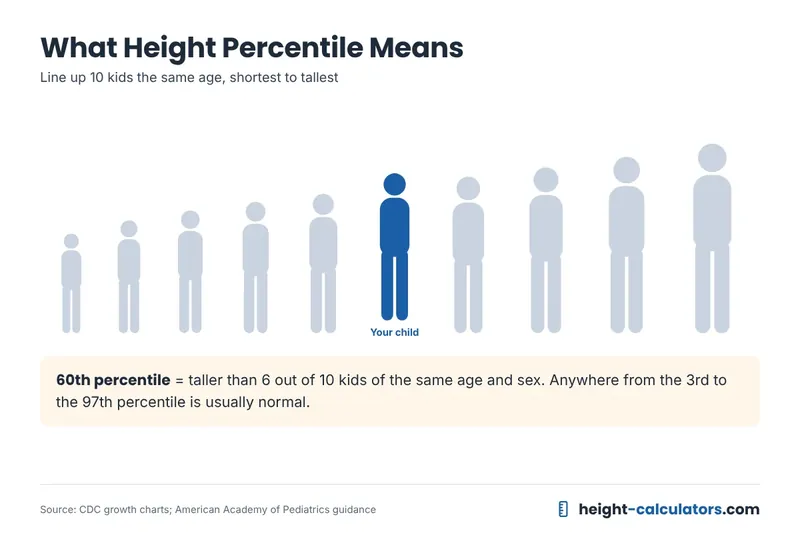
A height percentile tells you how many kids out of 100 are shorter than your child. It's a ranking, not a grade, so a lower number is not "worse".
- 50th percentile: right in the middle. Half of kids are taller, half are shorter.
- 90th percentile: taller than 90 out of 100 kids the same age.
- 10th percentile: taller than 10 out of 100 kids. Still normal.
- Below 3rd or above 97th: worth a chat with your pediatrician.
Height Percentile Calculator for Boys and Girls
Boys and girls grow on different schedules, so each sex has its own chart. Always pick the right one, or the height percentile will be off.
- Boys: grow fastest between 12 and 15, so a boy's percentile can jump during his growth spurt.
- Girls: grow fastest between 10 and 14, so girls often rank higher than boys at 11 to 13.
- Both: a short-term jump or dip around puberty is common. The long-term trend matters more.
Baby and Toddler Height Percentile Calculator
For children under 2, the calculator uses the WHO growth standards, which is what most pediatricians use for babies. Babies are measured lying down (length), so measure the same way at home for a fair result.
- Babies grow about 10 inches in their first year, then about 5 inches between 1 and 2.
- Small swings between checkups are normal at this age.
- One reading tells you little. Track your baby's length percentile over several months.
CDC vs WHO Height Percentile: Which Chart Do We Use?
We follow the American Academy of Pediatrics advice: WHO charts from birth to 2, CDC charts from 2 to 20. The two charts can give slightly different percentiles because they're built from different groups of children.
- WHO (0 to 2): shows how healthy babies grow in good conditions, worldwide.
- CDC (2 to 20): shows how US children actually grew, from national survey data.
- That's why our CDC height percentile calculator and WHO height percentile results may differ slightly at age 2.
Is My Child's Height Percentile Normal?
Anywhere between the 3rd and 97th percentile is usually normal. What matters most is that your child stays near the same percentile line as they grow.
Talk to your pediatrician if your child:
- is below the 3rd or above the 97th percentile
- moves up or down across two or more major percentile lines, for example from the 75th to the 25th
- is growing far shorter than you'd expect from your own heights
Want to know how tall your child will be as an adult? Use our height calculator to predict adult height.
Adult Height Percentile Calculator
The tool also works for adults aged 20 and over. The average US man is about 5'9" (68.9 in, 175 cm) and the average US woman is about 5'3½" (63.5 in, 161 cm), per CDC measurements from 2021–2023.
- A 6'0" man is taller than roughly 8 in 10 US men.
- A 5'7" woman is taller than most US women.
- Enter your own height to see your exact adult height percentile.
Height Percentile Calculator FAQ
What is a good height percentile for a child?
Any percentile between the 3rd and 97th is normal. A child steadily growing along the 15th percentile is just as healthy as one on the 85th.
Can height percentile predict adult height?
Roughly. Many kids stay on the same curve, so a child on the 75th percentile often ends up taller than average. For a real estimate, use our height calculator.
Why did my child's height percentile drop?
Small changes are normal, especially around puberty. A drop across two major lines, like 50th to 10th, is worth checking with a doctor.
Is height percentile the same as BMI percentile?
No. Height percentile ranks height only. BMI percentile looks at weight compared with height.
Height Percentile Calculator References
- Centers for Disease Control and Prevention. CDC Growth Charts, 2000.
- World Health Organization. WHO Child Growth Standards.
- CDC. FastStats: Body Measurements (NHANES 2021–2023).
- American Academy of Pediatrics guidance on using WHO charts under 2 and CDC charts from 2 to 20.
Disclaimer: This calculator gives an estimate for general information only. It is not medical advice. See our medical disclaimer.