When Do Boys Stop Growing?
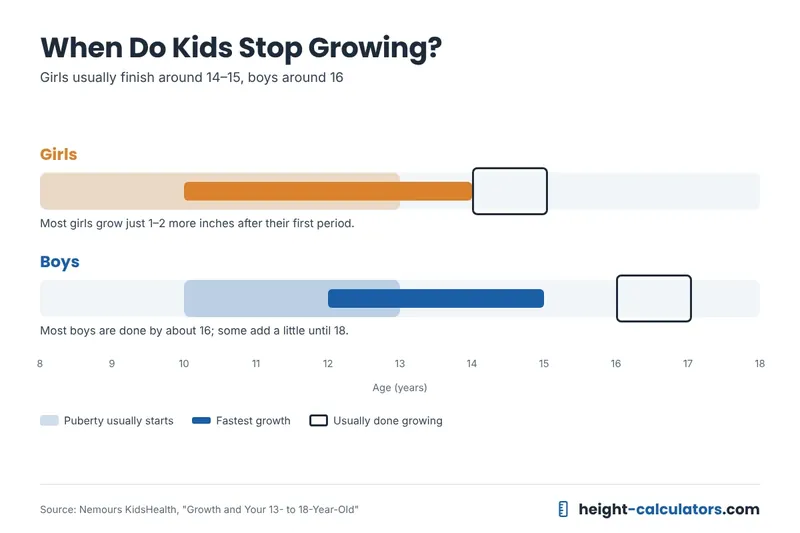
Most boys stop growing in height by about 16, and some add another inch or so until 18. Growth ends when the growth plates in the bones close, a few years after puberty starts. Want to know how tall your son will be? Try our height calculator.
When Do Boys Hit Their Growth Spurt?
Most boys start puberty between 10 and 13 and grow fastest between 12 and 15. That's about two years later than girls, which is why many girls are taller than boys at 12 and 13.
- Start of puberty: usually 10 to 13.
- Fastest growth: usually 12 to 15, often 3 to 4 inches a year.
- The spurt lasts: about 2 to 3 years.
- Late bloomers: some boys don't start until 14. That's usually normal, but worth mentioning to the doctor.

What Age Do Boys Stop Growing Taller?
By 16, most boys are at or very close to their adult height. A few keep growing slowly into their late teens, usually less than an inch.
- By 16: most boys have stopped growing taller.
- 16 to 18: small gains for some, mostly late bloomers.
- After 18: very little height gain for almost all men.
- Muscles: keep developing into the 20s, so boys often look bigger even after they stop growing taller.
Average Height for Boys by Age
The table shows the median height for boys from 10 to 20, from the CDC growth charts. Notice the big jump between 12 and 15, then how little changes after 17.
| Age | Average height (ft/in) | cm |
|---|---|---|
| 10 | 4'6½" | 138.9 |
| 11 | 4'8½" | 143.8 |
| 12 | 4'11" | 149.4 |
| 13 | 5'1½" | 156.5 |
| 14 | 5'4½" | 164.1 |
| 15 | 5'7" | 170.2 |
| 16 | 5'8½" | 173.7 |
| 17 | 5'9" | 175.3 |
| 18 | 5'9½" | 176.3 |
| 20 | 5'9½" | 176.8 |
See every age from 2 to 20 on our height chart by age.
Signs Your Son Has Stopped Growing
The clearest sign is that he's grown little or nothing in the past year. Other puberty changes usually finish around the same time.
- Little or no height gain over 12 months
- His voice has fully deepened and no longer cracks
- Adult facial and body hair has come in
- Shoe size has stayed the same for a while
- He's reached 17 or 18 and puberty started at a typical age
Only a bone age X-ray can tell for sure whether the growth plates have closed.
What Affects When Boys Stop Growing?
The timing of puberty matters most. Boys who start puberty early often stop growing earlier; late bloomers keep growing later and can catch up.
- Genes: boys often follow a similar timing to their father.
- Nutrition: poor nutrition in childhood can delay growth.
- Weight: being overweight can change when puberty starts and how fast boys grow.
- Health: some long-term illnesses and hormone problems slow growth.
- Sleep and activity: good sleep and regular exercise support normal growth.
How Tall Will My Son Be?
The best estimate uses his current height, weight and age, plus both parents' heights. Our height calculator does exactly that with the Khamis-Roche method, usually within about 2 inches.
- Under 4? Use the mid-parental height calculator instead.
- Re-check once a year. Each new measurement makes the estimate more accurate.
When to See a Doctor About Your Son's Growth
Most boys who seem "behind" are simply late bloomers. Still, check with your pediatrician if your son:
- shows no signs of puberty by about 14
- grows less than about 2 inches a year before puberty
- is far shorter than you'd expect from your own heights
- drops across two or more lines on his growth chart
FAQ: When Do Boys Stop Growing
Can boys grow after 18?
A little, in some cases. Most boys have stopped by 18, and growth after that is usually under an inch.
Do boys grow after puberty ends?
Very little. Height growth stops when puberty finishes and the growth plates close.
Is 16 too late for a growth spurt?
No. A late bloomer can still be in his growth spurt at 15 or 16 and keep growing until 18.
How much do boys grow during puberty?
On the CDC chart above, the average boy grows about 10 inches between 12 and 17, with the fastest years adding 3 to 4 inches each.
References: Nemours KidsHealth, "Growth and Your 13- to 18-Year-Old"; CDC growth charts (2000), stature-for-age, boys 2–20.
Disclaimer: This article is for general information only and is not medical advice. Talk to your pediatrician about your child's growth.
Try it: Height Calculator · Height Percentile Calculator · Mid-Parental Height Calculator